Monday, October 4, 2010

It's Fire Prevention Week!

October 3 - 9 marks the annual week that the fire service declares as National Fire Prevention Week. Fire prevention week commemorates the Great Chicago Fire which occur ed started on October 8, 1871 which destroyed much of the city over the course of three days. The first fire prevention week was declared in 1925 by President Calvin Coolidge. Each year the fire service selects a theme so that firefighters all over the United States can remind their communities how to be safe from the perils of fire. This year the national theme is "Smoke alarms, a sound you can live with!"

In Forest Grove we actually take the entire month of October and work specifically with our elementary schools to start this safety message with our youngest audience. In the coming weeks our Fire and Life Safety Division will visit almost all of our K-4 schools in the coming weeks sharing safety information with the kids and answering their questions about firefighters and fire safety. All of this culminates with our annual Public Service and Safety Open House which will be held this year on Saturday October 16th at our Forest Grove Fire Station.

Smoke Alarms, a Sound You Can Live With Safety Tips
  • Install smoke alarms inside each bedroom, in the hallway outside the bedrooms, and on each floor of the home. Avoid placing smoke alarms near kitchens and bathrooms where steam and smoke can cause frequent false alarms.

  • Replace your smoke alarms every ten years.

  • Test your smoke alarms monthly and practice a family fire drill when you do. Many kids do not know what to do when they hear their smoke alarm so they react by hiding instead of escaping the home. Teach your kids how to safely get out of the home and meet at the family emergency meeting place.

  • Keep your smoke alarm clean by gently dusting or vacuuming it regularly, if it chirps consider replacing the battery or the entire alarm.

Thursday, September 30, 2010

Fall Backyard Burn Season

Friday October 1st is the official kick off for the fall backyard burn season. From October 1st to December 15th the Oregon Department of Environmental Quality (DEQ) allows residents to burn the yard debris from their property. Backyard burning is allowed in and around Forest Grove, however it's not a burning free for all and there are a number of rules that must be followed to avoid a visit from us or a letter in the mail from the DEQ.

First only burn on open burn days. Each day the DEQ tests the air quality in our area and based on this test they will let us know if burning is allowed that day or not. We update the Washington County Open Burning Hotline each morning with this information. You can hear our pre-recorded message by calling 503.992.3242 to see if you can burn that day. It is very important that you burn only on open days during the time limits allowed.

Second, be sure that you are only burning allowed materials. Backyard burning is for yard debris like limbs, clippings, and leaves. You cannot burn items like lumber, garbage, paper, plastics, or tires. Each year there are also questions from people that live in the rural area about agricultural (Ag) burning. Ag burning is for the removal of debris from a farming operation, just because a person may live in the country they are not considered Ag burning by default. For instance a filbert grower who burns the limbs from his orchard is considered to be ag burning but if the same farmer was to burn some hedges that he pulled out from around his home this would fall under the backyard burning requirements instead of those for Ag.

Third be fire safe and a courteous neighbor when you burn. Make sure your pile is dry before you light it off. Smoke complaints are one of the big reasons we get called by angry neighbors so a dry burn pile will help you burn cleaner without putting off a large amount of smoke. Locate your burn pile away from property lines and so that it is well clear of fences, buildings, trees, and anywhere else where you do not want the fire to spread. Constantly attend to your pile while it is burning and have firefighting equipment like a garden hose and hand tools close by to help control the fire. When you are done burning wet down the burn pile and the area around it with water so to be sure that the fire is completely out and will not flare up after you leave it.

We obviously encourage that you choose non burning methods such as composting or the curbside yard debris removal service instead of burning, but we understand that these options are not always good ones for every property owner. For more information check out the Oregon DEQ website about backyard burning by clicking on this link. To report an illegal burn or smoke related complaint please do not call our fire station, instead call 503.229.5393 and report it to the DEQ directly. If a burn pile gets out of hand always call 9-1-1 immediately.

Monday, September 13, 2010

9-11 Memorial in Forest Grove

Even though Forest Grove, Oregon is just about as far away from the east coast of the United States as you can get, we as Americans were all touched by the events of September 11, 2001. For those in the fire service, it was the largest loss of life in the line of duty in one day in the history of our profession. On that tragic day 2,977 innocent Americans were killed in the terrorist attacks in New York, Washington DC, and Pennsylvania. In the City of New York 343 members of the Fire Department New York, and 60 law enforcement officers were killed while trying to serve the people trapped in the buildings of the World Trade Center. September 11, 2001 is regarded as the single most deadly day for firefighters and police officers in the history of the United States.

Last Saturday was the nine year anniversary of the attack on our country and we were joined by firefighters, police officers, current military members and veterans, as well as community leaders from all over western Washington County for a ceremony to remember one of the most significant events of our generation. We gathered alongside about 50 of our community neighbors at the community flag pole on Pacific Avenue in Forest Grove to remember the tragic day that will forever be recognized as a defining moment for the fire service.


Wednesday, September 1, 2010

Purchase of AED units will provide for better response to cardiac emergencies

In an effort to improve our ability to respond to cardiac emergencies we have recently completed the purchase of six new automated external defibrillators, commonly called AED's, and placed them in service on a number of our emergency vehicles. Prior to this purchase we only had four of these units (three at Station 4 in Forest Grove, and one at Station 7 in Gales Creek) and there were times when all of these could have been tied up on calls so we made it a priority in this year's budget to ensure that we were able to add to our inventory with the total cost of these new devices coming in at $13,800 dollars. In total we now have ten of these life saving tools ready to respond to emergencies in our community.


One of our new Phillips FR2 AED with ECG Units shows a normal heart rythym during testing last week

For the last few years you may have been seeing more and more AED's in the community. You can find them at malls, stores, airports, public swimming pools, offices, and other public places where they are becoming just as commonplace as a fire extinguisher or first aid kit. You really can't fault this either as statistics from the Heart Rhythm Foundation show that there are approximately 325,000 deaths per year from sudden cardiac arrest and that 93 to 95% of sudden cardiac arrest victims die before they even reach the hospital. Studies involving better access to a defibrillator show that the survivability rates increase to 50% or better when an AED is applied within minutes of the event. The Phillips model FR2 AED that we purchased is quite a bit different from the ones you see in public places however, all in a good way. According to our Emergency Medical Services Officer, Paramedic Will Murphy "These are not an AED alone like in the mall, our units have the capability for us to monitor the ECG (electrocardiography) of the patient and get us a better look at what is creating the reason they called 9-1-1."

Our new AED's will also allow us to work more efficiently. According to Murphy "These devices match the current ones that we use so no additional training will be needed, in fact they are able to be used by all certification levels of EMT from the Volunteer Firefighter/First Responder to the career Firefighter/Paramedic." In addition the Phillips FR2 model is compatible with other local area emergency crews so that we will be able to disconnect the cord and plug them directly into the same unit from Metro West Ambulance when they arrive to take the patient to the hospital. One more added benefit for our department is that we can also record data on these so that we can do regular quality control checks on our calls to ensure that we are indeed providing the first class emergency medical care that we would expect.


FGF&R Emergency Medical Services Officer Will Murphy places one of the new AED units on our Engine 423, until last week's purchase this engine did not carry an AED as part of it's normal compliment of equipment


An AED works by analyzing your heart rhythm to determine if an electrical shock is needed to help restart your heart's natural electrical balance. Some AED units that are in public places are truly automatic, meaning that you turn the machine on and a computer voice will tell you exactly how to apply the patches, the machine will then take it from there and deliver electricity as needed automatically. Our AED units are slightly different in that we have to actually push a button to enable them to deliver the electricity needed to "restart" your heart. Still these little machines are the most effective tool out there to help us save a life that has suffered from sudden cardiac arrest. This purchase ensures that every fire engine in our fleet as well as the vehicles driven by our Chiefs and Fire Inspector will carry an AED ready to respond to the needs of the community.

Monday, August 30, 2010

Fire Safety for Hunting Season

This week a special guest blogger will be posting on our page. Lana Limbeck is a 2010 graduate of Forest Grove High School and volunteers in our Fire and Life Safety Division. Lana will be starting her college fire science studies soon, and to get her started we gave her a "homework assignment" to create a fire safety blog post related to the start of hunting season. Good job Lana, hope our readers enjoy it.


Summer is already coming to a close to the disappointment of many, but for some Oregon hunters it only brings excitement. Fall ushers in an exciting time for those preparing their plates for a little extra protein and their guns for this year's hunting season. Bow hunters kicked it off already this month and rifle hunting is due to begin later in the fall in October. Although August has blessed Forest Grove area residents with much cooler weather this year, it is important to remember that while summer may seem to be cooling off, the fire danger is still very high. This is especially true for hunters who will be spending a lot of time in the national forests in the next few months. When preparing your packing lists for this year’s hunting season, be aware of the dangers, restrictions, and laws regarding fire safety during the last month of summer.

According to charts provided by the Oregon Department of Forestry, wildfires are more prevalent throughout July, August, September, and even October. We may think that the danger ends in September, but depending on the weather, it can continue well into the fall. Until significant rainfall occurs, the ODF says that major restrictions will remain in place well into the fall.


This brush fire burned approximately an acre and was believed to have been started by a hunter on SW Fernhill Road last year


There are many restrictions currently in place on all Tillamook state forests and surrounding properties due to the current fire danger. Forest fires are too often caused by unattended campfires and smokers who fail to extinguish their cigarettes. To prevent this, the ODF has placed a ban on both. Absolutely no campfires are allowed on public or private land except in designated areas such as campgrounds. Smoking is prohibited unless kept inside closed vehicles on improved or well-maintained roads. ATV's and motorcycles are not permitted unless on improved roads because of the dry conditions and no non-industry use of chainsaws is allowed in any case.

The heavy restrictions may disappoint many hunters who plan on camping, but it is imperative to pack according to the current regulations. One very important thing to know when creating a packing list is this: when traveling on any unpaved county or logging roads all hunters must carry a fire extinguisher or one gallon of water and one shovel in their vehicles. It's not just a recommendation this year, it is required.

The regulations and fire dangers are different for every unit and area so it is very important to know and understand the regulations for the unit you will be hunting in. You can find information about the fire dangers in your unit by contacting the Oregon Department of Forestry, or by visiting their website at http://egov.oregon.gov/ODF/.

FGF&R wishes for everyone to have a fun, successful, and safe hunt this year. Pack according to the current fire danger and remember to stay updated on the restrictions taking place in your unit. Enjoy your hunting season, and good luck!

Monday, August 23, 2010

New GPS units help us find you.

For years when firefighters would visit with school aged children we would talk about calling 9-1-1 and how the children needed to know their address when they called. As times changed and technology progressed, if you called 9-1-1 from a phone connected directly to a wall jack, our enhanced computer aided dispatch system could tell where you were calling from based on the phone you were using. This greatly improved our ability to respond timely when we could not get the caller to tell us where they were because the computer would tell us exactly where the phone was located.

In the 1990's with cell phones becoming more prevalent this became much more difficult. People would call and were not sure of their address, dispatchers had to use landmarks to help the caller identify where they were close enough to be able to give us accurate information which took valuable time away from our response. In recent years the cell phone and dispatch technology has evolved so much that now our dispatchers can sometimes locate your place on earth by your cell phone signal. At our dispatch center in Tanasbourne a dispatcher could use their computer to determine the latitude and longitude of the callers location based on their cell phone signal. As people abandoned their traditional land line home phones for cell phones this became all the more important of a tool to be able to use.

Last week we installed Global Positioning Satellite (GPS) units in our Engine 421 and Rescue 4 that enable us to use this cell phone location information on our end and direct our crews right to the scene. This is so vitally important when you consider how much of our 85 square miles of response area is really rural. It could be a farmer in the middle of a field in Verboort having chest pains while moving his irrigation, a mountain bike rider who has crashed on one of the local trails, or a child calling for their sick mother from a home in the city, but we hope that these new GPS units will help us respond quicker when seconds really do count.


These small GPS units in our engine and rescue can have a big impact on our ability to respond to an incident quickly when the caller isn't sure of their location.

In addition to the ability that these units provide us to find people they also help others find us. We use air ambulance resources like Lifeflight quite often and with our GPS units we can tell the pilots exactly where the landing zone is located. Don't worry however, we aren't abandoning the more traditional methods like paper maps that are still carried on our engines, and our firefighters will still train on basic road and area familiarization, but these electronic tools are just one of the many ways that we are looking towards technology to become more efficient improve our service to the community.

Tuesday, August 17, 2010

It may be "cooling off" but our fire season is just now starting to heat up

All over Forest Grove air conditioners are running non stop, kids are playing in sprinklers, and fresh cool Hermiston water melons are being enjoyed for dessert. At the same time we are already getting that feeling that fall is coming - Monday Night Football was on last night, Pacific University students are starting to return to campus, and parents are buying school clothes and supplies and getting their kids to bed a bit earlier each night in anticipation of the arrival of school and the unofficial end of summer. It's important to remember however that in Oregon our wild fire season is really just getting started, and may still be more severe then we've seen in years.

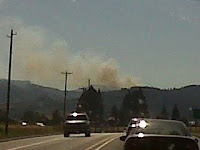
In July the 15 acre fire on the slopes of David Hill was not only easily visible from anywhere in Forest Grove as the smoke drifted over our neighborhoods, but it was also one of the largest fires in our community in recent history. This weekend almost 80 acres burned just a few miles south of us in the northern part of Yamhill County. Just weeks ago the Rooster Rock Fire near Sisters threatened homes, and 800 acres currently burning near Grants Pass is in danger of doing the same. All over the northwest crews are working the fire lines waiting for the fall rains to arrive that will end fire season 2010.


This cell phone photo shows the smoke column from the David Hill Fire in July


Now is the time to remember the old phrase "It's always darkest just before the dawn". We all remember the long winter that stretched into the spring; this has allowed fuels such as brush and grass to be more abundant then normal years and the recent dry weather has made for tinder box like conditions around us. We hear every year about fires in southern and central Oregon, but northwest Oregon has not experienced a large fire in decades leaving us extra vulnerable and complacent when it comes to fire danger. But we are at risk and history proves it, until Southern Oregon's 2002 Biscuit Fire our very own 1933 Tillamook Burn was the largest fire in our state in generations, and it started on August 14th of that year. The 1933 Tillamook Burn destroyed over 240,000 acres of the very same timbered hillsides that we all see when we look west to watch the sunset or drive over the hill to visit the coast.

So what can we do? Even if it does cool down into the 70's this week and stays that way until the October rains arrive we cannot let our guard down. September can be one of the busiest months for brush fires, and just a few years ago we fought a stubborn October brush fire all night long with frost on the ground when we were done. Now is the time for caution and attention to everything we do outside. Carry a fire extinguisher in your car, make sure your lawn mower or tractor is in good working condition, put a little extra water on that old burn pile or campfire or pig roast pit and make sure it's out, and if the signs in your camp site say no camp fires please don't start one. If you see smoke call 9-1-1 immediately, fires can spread rapidly and we would rather check on a small fire then have to try and control one that is growing by the acre instead of the inch. If we work together we can make sure that the summer 2010 is rememberd for fun family activities instead of tragic wild fires.